The Australian dollar hit a four-year high as rising interest rates attract global investors, boosting demand for AUD.
Unless you’re counting down to a Euro summer or have side hustle importing goods from overseas, the Australian dollar probably isn’t on your radar.
But it should be.
The Aussie dollar has recently surged to a four-year high, around 0.71905 US dollars (as of the 1st May 2026), outperforming most major currencies.
Here's the thing… right now, the AUD is on a run. And the RBA is a big part of the reason.
Australia is doing something different
Right now, most major central banks are hitting pause on cash rate hikes.
The US, UK, Europe and Canada are all in “wait and see” mode - holding interest rates steady while they figure out what happens next for inflation and growth.
But Australia isn’t.
The Reserve Bank has already raised rates multiple times this year, and markets are betting there’s more to come.
That makes Australia a bit of an outlier - and in currency markets, being different matters.
Think of it like chasing the savings account with the highest interest rate, except on a much bigger scale.
Highest interest rates = better return for investors.
So when Australia offers higher rates than other countries, global investors move money into Australian assets (like bonds) to capture those returns.
But to invest here, they need Australian dollars. And that increased demand pushes our currency higher.
The real driver isn’t just that Australian rates are high, it’s that our rates are higher than many of the world’s major economies right now.
This is what economists call an interest rate differential.
If Australia keeps raising rates while other countries stay on hold, the incentive for global money to flow here gets even stronger.
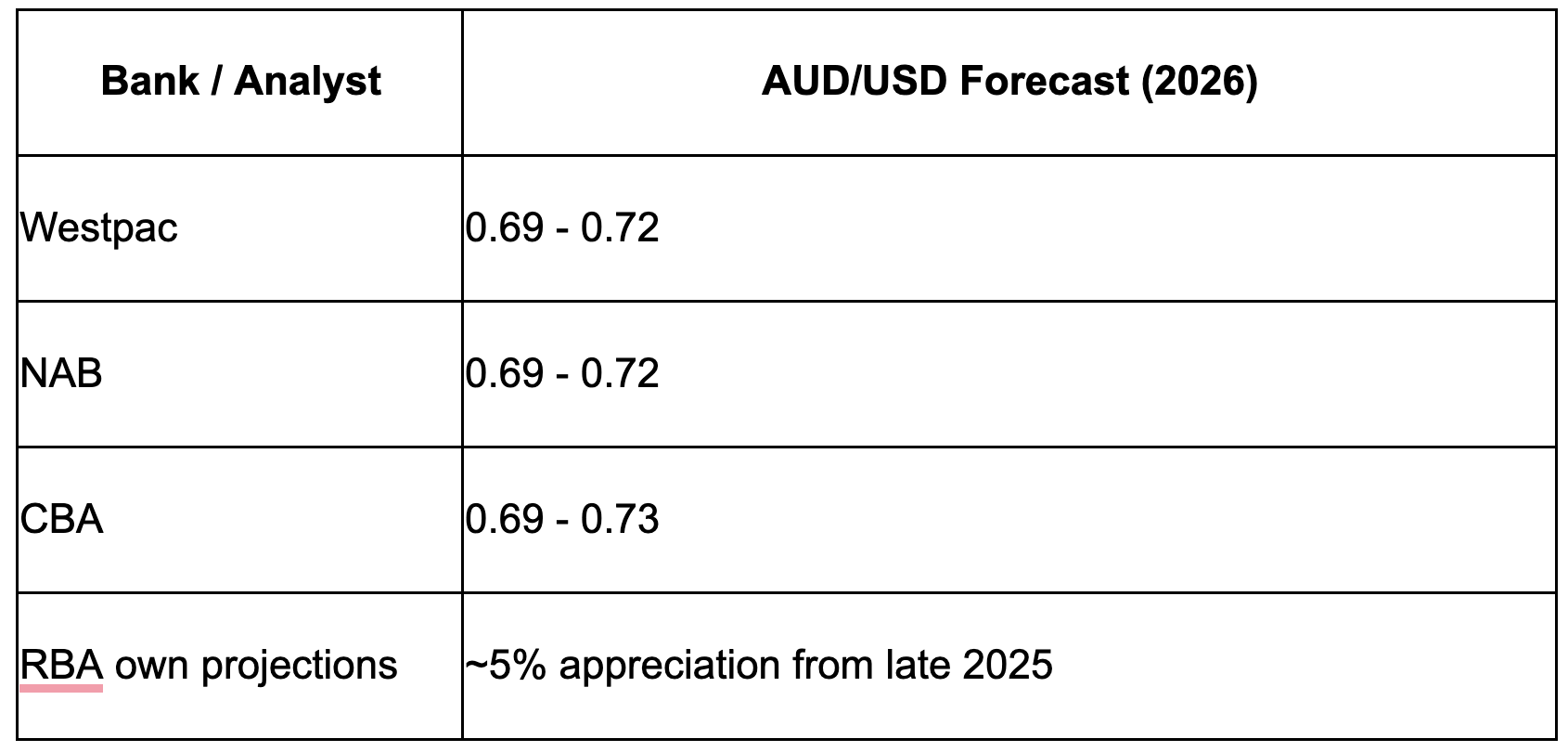
Westpac and NAB are clustering around the 0.69 - 0.72 USD range for mid-2026, with CBA predicting an upside to 0.73 if global sentiment improves and the US dollar keeps softening.
The Fed is expected to hold or cut while the RBA keeps hiking, which only widens that yield gap further.
There’s one more piece of the puzzle.
The Aussie dollar tends to perform best when investors are feeling optimistic about the global economy.
That’s because Australia is closely tied to global trade and commodities like iron ore, energy and materials, which thrive when growth expectations are strong and investors are willing to take on more risk.
And right now, that’s the environment investors think we’re heading towards.
Stock markets are hitting highs, volatility is easing, and investors are increasingly pricing in a more stable global outlook.
This gives the Aussie dollar an extra lift.
The flip side? The Aussie dollar is sensitive.
If global markets wobble, the Aussie dollar is usually one of the first currencies to fall.
And if the Reserve Bank signals it’s done raising rates, the Aussie dollar loses a lot of its current shine.
✈️ Travel & spending: A stronger dollar increases your buying power overseas
📉 Investing: International investments can feel weaker when converted back to AUD
💸 Interest rates: A strong dollar often comes with higher rates sticking around which is great for savers, but not so good news for mortgage owners
If you've been eyeing an overseas trip or a big international purchase, the timing might be better than it's looked in a while - so it’s worth keeping an eye on that exchange rate before you book.
And now that you know how rate hikes feed into a stronger dollar, you've got one more tool in your financial toolkit. Use it!
All information contained in the Flux app, www.flux.finance, www.joinflux.com, app.flux.finance and any podcast of Flux Media Pty Ltd (ABN 27 639 804 345) is for education and entertainment purposes only. It is not intended as a substitute for professional financial, legal or tax advice. While we do our best to provide accurate information on the podcast, we accept no responsibility for any inaccuracies that may be communicated.
Flux does not operate under an Australian financial services licence and relies on the exemption available under section 911A(2)(eb) of the Corporations Act 2001 (Cth) and ASIC RG 36.66. Flux Technologies Pty Ltd provides general advice on credit products under our own Australian Credit Licence No. 530103. The product information presented does not constitute an offer and we are not recommending or suggesting any particular product.
Sign up for Flux and join 100,000 members of the Flux family


