Two global bond ETFs can hold the same bonds but deliver very different returns. The culprit? What the Aussie dollar is doing behind the scenes.
In partnership with:
You lock in flights for a trip. Dream about it for a few weeks. You check the exchange rate when you book the hotel, and somehow when you get there, the accommodation ends up being 5% more than when you booked it.

That's currency risk. And it turns out it doesn't just live in your travel money, it can be sitting inside your bond ETF too.
Two global bond ETFs can hold almost identical bonds and still deliver noticeably different returns, purely because of what the Aussie dollar was doing in the background.
But there's a simple way to manage this, and it's usually spelled out right there in the ETF's name.
Bonds are usually the "boring but stable" part of a portfolio. Currencies are not. US Treasury bond yields typically sit in the 4-5% range, moving only a few tenths of a percentage point even during a near-three-year high. While the Aussie dollar can move far more than that against the US dollar over the same period, appreciating roughly 10% against the USD across 2025 to early 2026.
That's the problem. If a global bond ETF doesn't manage that currency exposure, the currency swing can end up having a bigger impact on your return than the bonds themselves.
Hedging means protecting yourself against a risk you're already exposed to, like paying for travel insurance in case a trip falls through. For bonds, currency hedging works by locking in an exchange rate ahead of time, so a fund knows roughly what its overseas bond income is worth in Aussie dollars, no matter what the currency does in between.
Some global fixed income exposures use this kind of hedging. It aims to strip out the currency swing, so you're investing for the diversification benefit rather than making a side bet on the Aussie dollar. Hedging isn't free and doesn't remove all the risk, but it's the difference that decides whether you're just buying bonds, or buying bonds plus a currency bet.

Hedged vs unhedged comparison
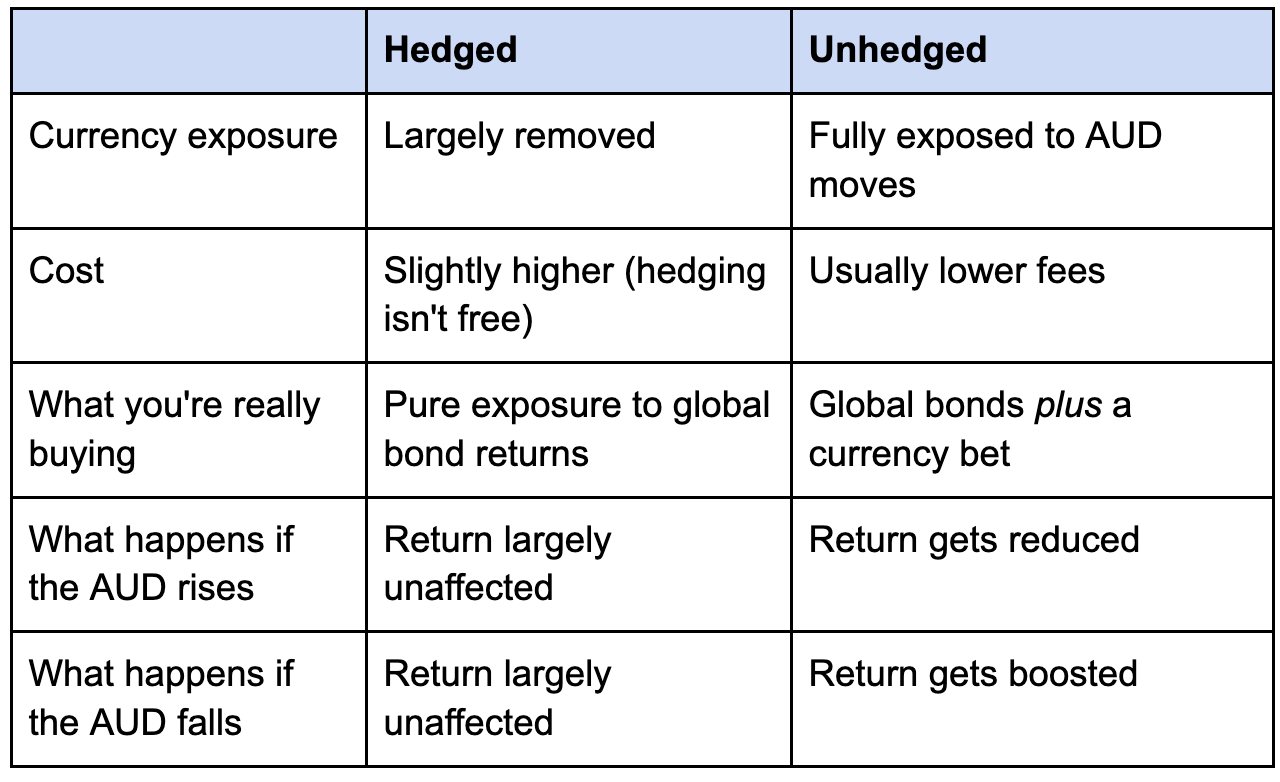
Neither option is right or wrong, they're built for different risk tolerances and portfolio goals.
Next time you're looking at a global bond ETF, check its name and PDS. "AUD hedged" (or similar) in the title is your clue. If it's not there, assume you're carrying currency risk too, and decide whether it suits your goals.
Franklin Templeton offers a range of fixed income strategies, some of which are structured with currency hedging in mind for Australian investors. Every fund's PDS or Target Market Determination (TMD) will state clearly whether it's hedged or unhedged so it's worth checking before assuming.
Find out more about Franklin Templeton’s fixed income capabilities
Hedged or unhedged, you're still holding the same bond. What changes is whether the currency is part of your return, or a variable you've chosen to remove.
Disclaimer:
All information contained in the Flux app, www.flux.finance, www.joinflux.com, app.flux.finance and any podcast of Flux Media Pty Ltd (ABN 27 639 804 345) is for education and entertainment purposes only. It is not intended as a substitute for professional financial, legal or tax advice. While we do our best to provide accurate information on the podcast, we accept no responsibility for any inaccuracies that may be communicated.
Flux does not operate under an Australian financial services licence and relies on the exemption available under section 911A(2)(eb) of the Corporations Act 2001 (Cth) and ASIC RG 36.66. Flux Technologies Pty Ltd provides general advice on credit products under our own Australian Credit Licence No. 530103. The product information presented does not constitute an offer and we are not recommending or suggesting any particular product.
This is issued for information purposes only and does not constitute investment or financial product advice. It expresses no views as to the suitability of the services or other matters described in this document as to the individual circumstances, objectives, financial situation, or needs of any recipient. You should assess whether the information is appropriate for you and consider obtaining independent taxation, legal, financial or other professional advice before making an investment decision. Neither Franklin Templeton Australia, nor any other company within the Franklin Templeton group guarantees the performance of any Fund, nor do they provide any guarantee in respect of the repayment of your capital.
Please read the relevant Product Disclosure Statement (PDSs) and any associated reference documents before making an investment decision. In accordance with the Design and Distribution Obligations requirements we maintain Target Market Determinations (TMD) for each of our Funds. All documents can be found via www.franklintempleton.com.au or by calling 1800 673 776.
Issued by Franklin Templeton Australia Limited (ABN 76 004 835 849, AFSL 240827).
Sign up for Flux and join 100,000 members of the Flux family


