Australia's wages aren't stretching as far as they used to. Here's why living standards are slipping... and why it's not just about spending habits.
If you feel like you pay lands in your account one day, only to get eaten up by your bills and a trip to the supermarket the next… it’s not just you.
The average pay in Australia doesn’t stretch as far as it used to. A decent salary back in your parents' 20's, won’t get you the same bang for your buck in 2026.
And this isn’t just an observation to fuel arguments around the family dinner table (cue Uncle John’s theory on Gen Z choosing matcha over home ownership).
The data points to somewhere other than our spending habits…
Australian real wages have fallen 5% between 2021 and 2026,according to OECD data from July 2026. Reminder: real wages reflect the actual purchasing power of what you earn because they are adjusted with inflation.
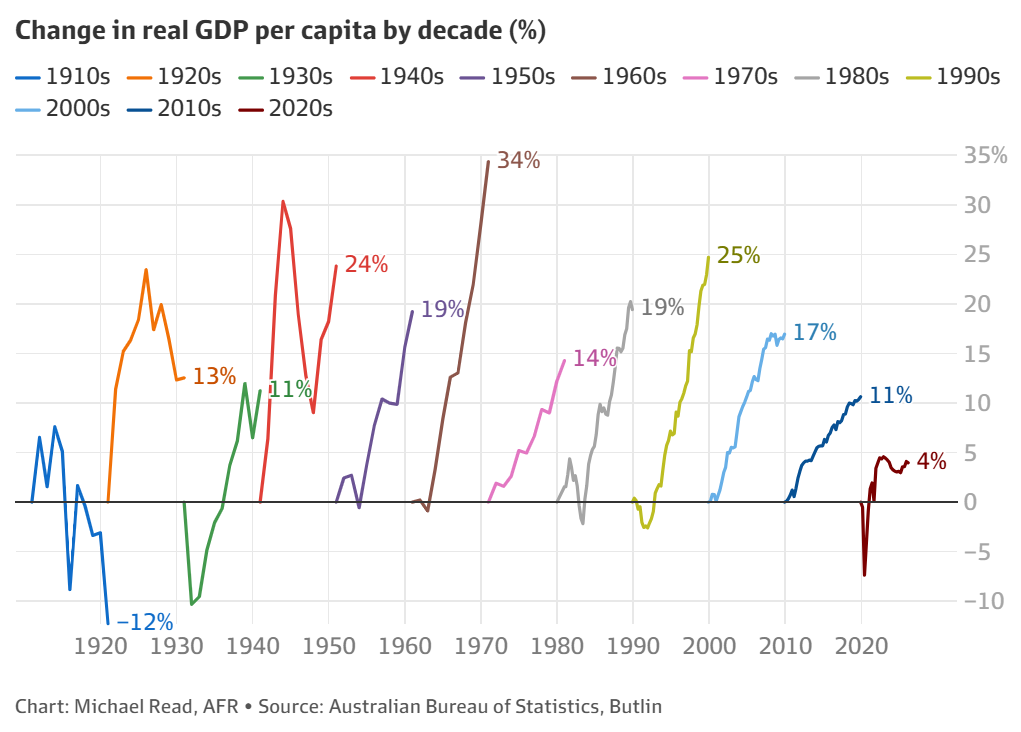
Not to be a downer, but that’s actually one of the worst results among the 38 OECD countries. And so far this decade, Australia’s GDP has only gone up 4% per person. For context, GDP was hitting 25% in 1999, 17% in 2009, and 11% in 2019. So this puts the 2020s on track to be the weakest period for living standards since the 1910s if things don’t change in the next few years.
That’s not to say Australia is a bad place to live… far from it.
Australia has one of the best job markets in the OECD. Our unemployment rate was 4.4% in May 2026, below the OECD average of 4.9%. And compared to a lot of other western countries, we have it pretty good (there’s a reason we saw record highs of people moving here last year).
But just because we have better work opportunities and higher average wages than most other OECD countries, it doesn’t mean those wages are stretching as far as they previously did.
Standard of living comes down to access to the necessities of life. Think: a living wage, decent housing, and food. The basics.
It’s pretty much a measurement of what our pay allows us to consume.

When the average Aussie can afford the basics, plus a few comforts like eating out, going to concerts, treating yourself to take aways, or going on a holiday… the standard of living is pretty good.
Not to be confused with quality of life - which is a bit more subjective and measures happiness in relation to personal economic factors. ’Standard of living’ is a measurement of income and consumption.
Standard of living is measured from:
The data shows Australia's real wages are stagnating alongside GDP, which is causing our standard of living to slide. And it means more people in Australia are feeling like they’re earning to survive - rather than to live.
According to economists, this is because of a couple of things:
Although we’re pretty far away from the rest of the world, we still feel the effects of what’s happening overseas.
For example, a global pandemic or more recently the surge in global energy prices due to the conflict in the Middle East. Both have had a direct impact on the price of goods here, and it’s helping to fuel (already rising) inflation here.
Quick economics refresh: When inflation increases at a higher rate, every day costs go up. If our wages aren’t rising with those costs, we can’t afford to buy the things we used to. That’s what’s causing real wage growth to halt.
The other big factor?
Productivity is basically how much value each worker produces in an hour. When it goes up, businesses can pay people more without putting prices up (that's how real wages grow).
Australia's problem is that it's barely gone up at all. Businesses haven't been investing enough in the tools, tech and training that make each hour of work more valuable. So while our economy has kept growing overall, that's mostly come from having more people, not from each of us producing more. Which is exactly why GDP per person has flatlined while total GDP keeps ticking along.
Economists reckon the answer to our productivity problem is to encourage more innovative businesses to start up here in Australia. Because in theory, fostering businesses here that can make money from new tech that could help boost our next wave of economic growth.
And the former Reserve Bank governor Philip Lowe actually said we need “fundamental policy change” to encourage more business investment.
But recent tax reforms (which you can read about here and here) in this year's budget has actually caused uncertainty for a lot of small businesses, who say tax changes make it tricky and expensive to grow here.
While the Reserve Bank is pulling the levers it can to deal with Australia's inflation rate, getting our living standards back on track looks like a far more complicated challenge…
And probably not one you can solve by buying less matcha like your uncle who bought a house in 1992 would have you believe.
All information contained in the Flux app, www.flux.finance, www.joinflux.com, app.flux.finance and any podcast of Flux Media Pty Ltd (ABN 27 639 804 345) is for education and entertainment purposes only. It is not intended as a substitute for professional financial, legal or tax advice. While we do our best to provide accurate information, we accept no responsibility for any inaccuracies that may be communicated.
Flux does not operate under an Australian financial services licence and relies on the exemption available under section 911A(2)(eb) of the Corporations Act 2001 (Cth) and ASIC RG 36.66. Flux Technologies Pty Ltd provides general advice on credit products under our own Australian Credit Licence No. 530103. The product information presented does not constitute an offer and we are not recommending or suggesting any particular product.
Sign up for Flux and join 100,000 members of the Flux family


